Raw
The original submission: 3 photos
L1
Level 1: 23 lines
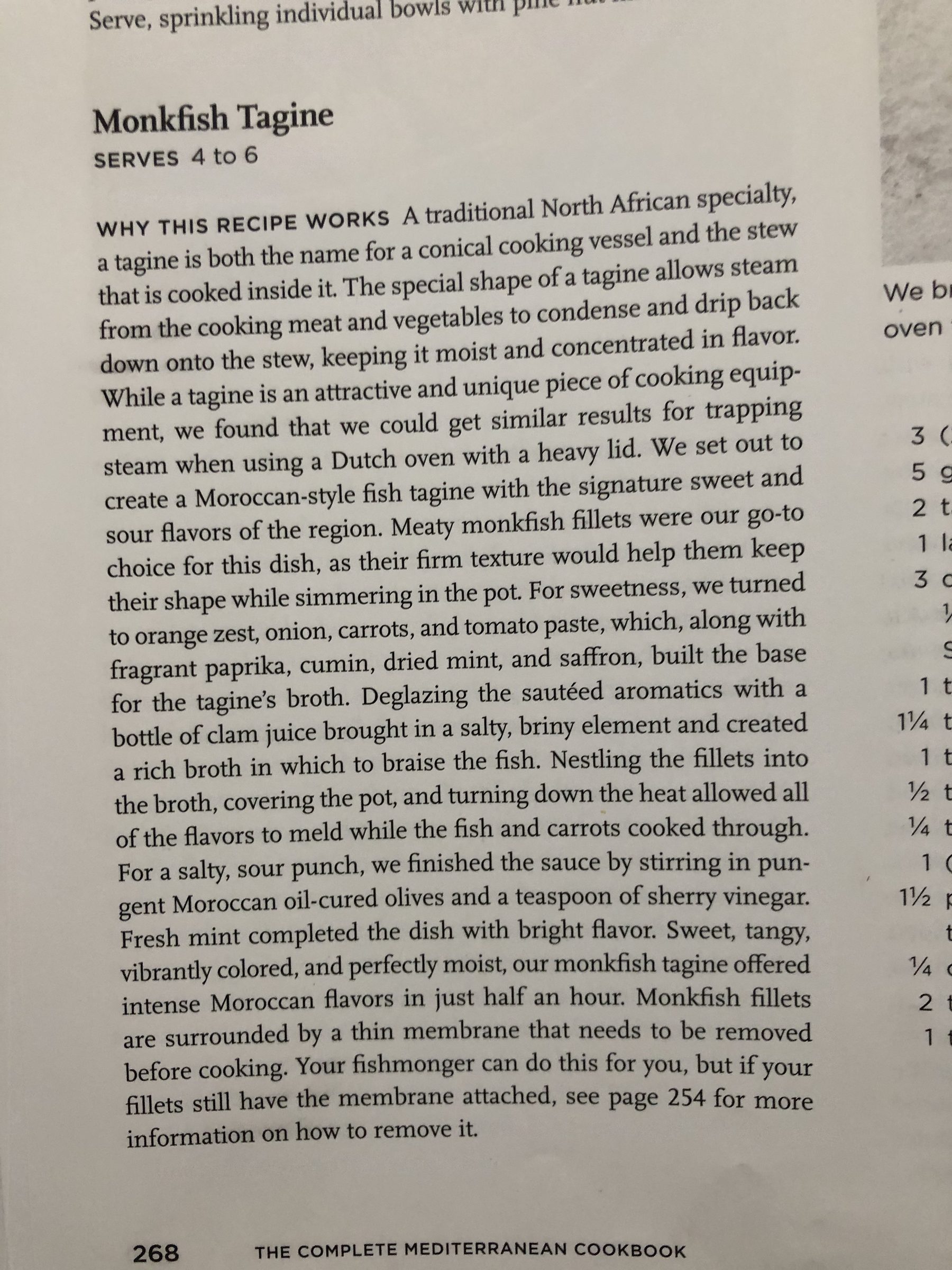
- 1Monkfish Tagine
- 2SERVES 4 to 6
- 3A traditional North African specialty, a tagine is both the name for a conical cooking vessel and the stew that is cooked inside it. The special shape of a tagine allows steam from the cooking meat and vegetables to condense and drip back down onto the stew, keeping it moist and concentrated in flavor. While a tagine is an attractive and unique piece of cooking equipment, we found that we could get similar results for trapping steam when using a Dutch oven with a heavy lid. We set out to create a Moroccan-style fish tagine with the signature sweet and sour flavors of the region. Meaty monkfish fillets were our go-to choice for this dish, as their firm texture would help them keep their shape while simmering in the pot. For sweetness, we turned to orange zest, onion, carrots, and tomato paste, which, along with fragrant paprika, cumin, dried mint, and saffron, built the base for the tagine's broth. Deglazing the sautéed aromatics with a bottle of clam juice brought in a salty, briny element and created a rich broth in which to braise the fish. Nestling the fillets into the broth, covering the pot, and turning down the heat allowed all of the flavors to meld while the fish and carrots cooked through. For a salty, sour punch, we finished the sauce by stirring in pungent Moroccan oil-cured olives and a teaspoon of sherry vinegar. Fresh mint completed the dish with bright flavor. Sweet, tangy, vibrantly colored, and perfectly moist, our monkfish tagine offered intense Moroccan flavors in just half an hour. Monkfish fillets are surrounded by a thin membrane that needs to be removed before cooking. Your fishmonger can do this for you, but if your fillets still have the membrane attached, see page 254 for more information on how to remove it.
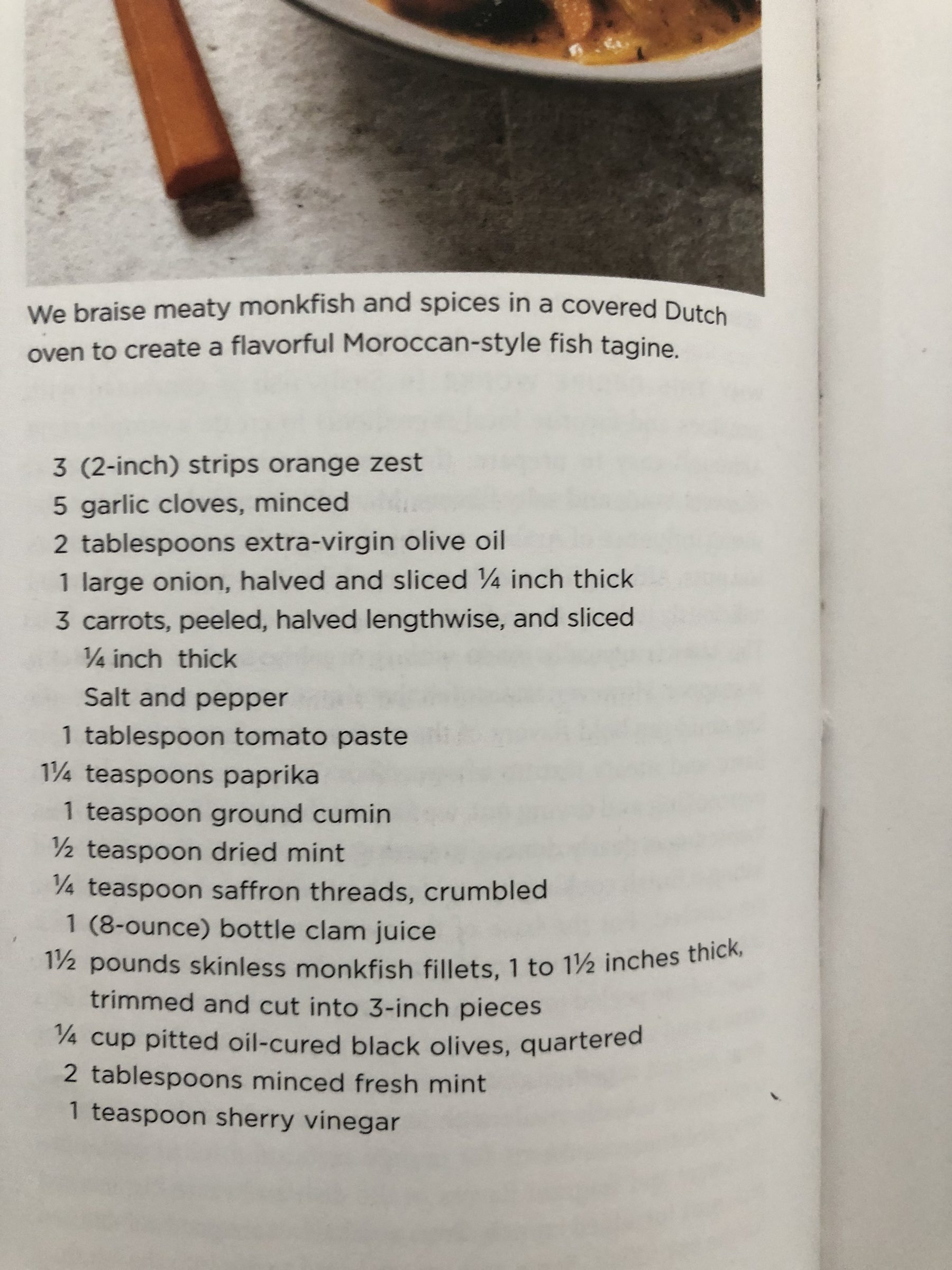
- 43 (2-inch) strips orange zest
- 55 garlic cloves, minced
- 62 tablespoons extra-virgin olive oil
- 71 large onion, halved and sliced ¼ inch thick
- 83 carrots, peeled, halved lengthwise, and sliced ¼ inch thick
- 9Salt and pepper
- 101 tablespoon tomato paste
- 111¼ teaspoons paprika
- 121 teaspoon ground cumin
- 13½ teaspoon dried mint
- 14¼ teaspoon saffron threads, crumbled
- 151 (8-ounce) bottle clam juice
- 161½ pounds skinless monkfish fillets, 1 to 1½ inches thick, trimmed and cut into 3-inch pieces
- 17¼ cup pitted oil-cured black olives, quartered
- 182 tablespoons minced fresh mint
- 191 teaspoon sherry vinegar
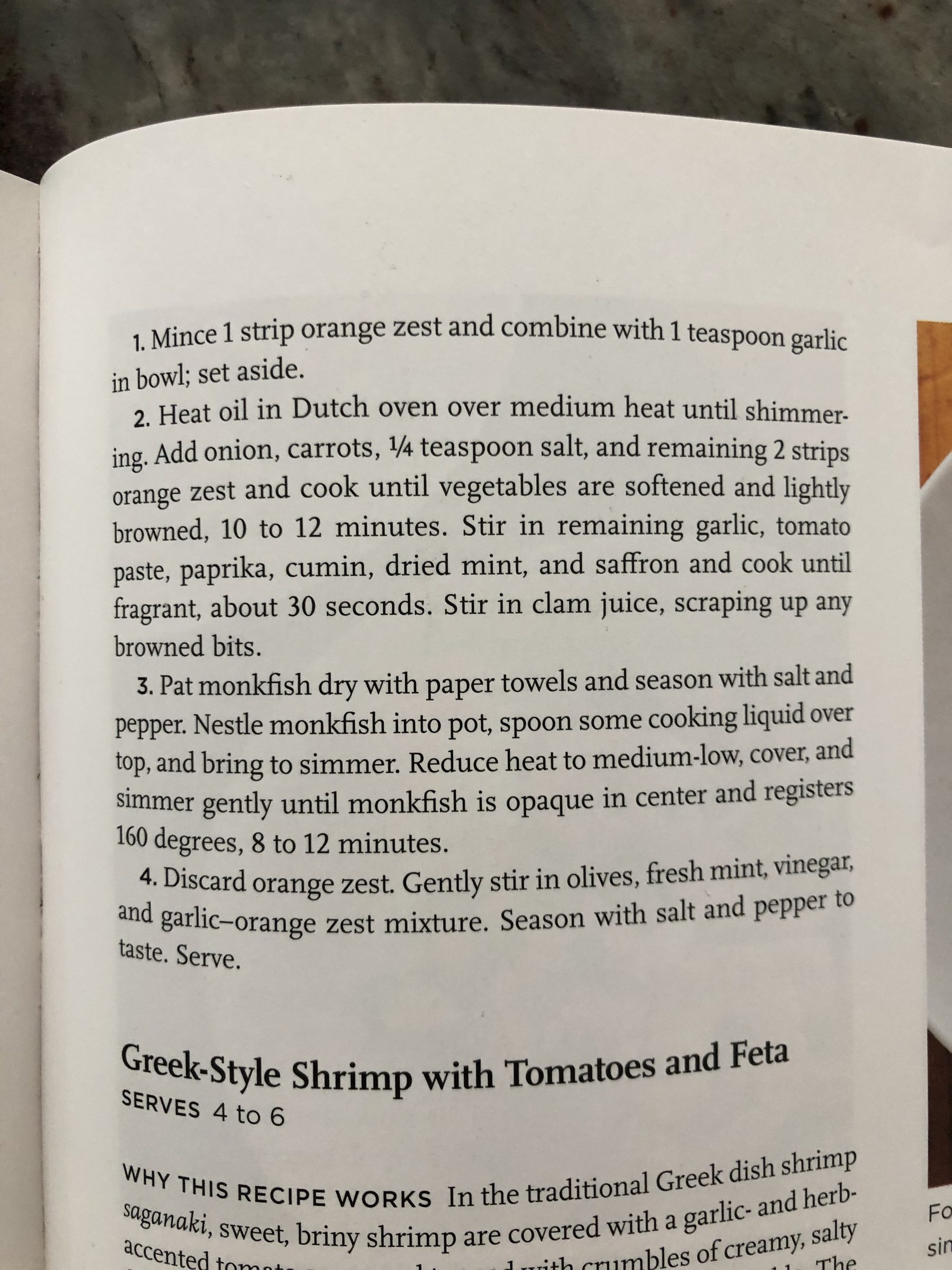
- 201. Mince 1 strip orange zest and combine with 1 teaspoon garlic in bowl; set aside.
- 212. Heat oil in Dutch oven over medium heat until shimmering. Add onion, carrots, ¼ teaspoon salt, and remaining 2 strips orange zest and cook until vegetables are softened and lightly browned, 10 to 12 minutes. Stir in remaining garlic, tomato paste, paprika, cumin, dried mint, and saffron and cook until fragrant, about 30 seconds. Stir in clam juice, scraping up any browned bits.
- 223. Pat monkfish dry with paper towels and season with salt and pepper. Nestle monkfish into pot, spoon some cooking liquid over top, and bring to simmer. Reduce heat to medium-low, cover, and simmer gently until monkfish is opaque in center and registers 160 degrees, 8 to 12 minutes.
- 234. Discard orange zest. Gently stir in olives, fresh mint, vinegar, and garlic–orange zest mixture. Season with salt and pepper to taste. Serve.
L2 corrected
Level 2, settled version (corrected), the newest
Title
| Title | Serves | Total time |
|---|---|---|
| Monkfish Tagine | 4 to 6 | (blank) |
Cook Time
| Prep | Cook | Total |
|---|---|---|
| (blank) | (blank) | (blank) |
Ingredients
| # | Ingredient | Heading |
|---|---|---|
| 1 | 3 (2-inch) strips orange zest | |
| 2 | 5 garlic cloves, minced | |
| 3 | 2 tablespoons extra-virgin olive oil | |
| 4 | 1 large onion, halved and sliced ¼ inch thick | |
| 5 | 3 carrots, peeled, halved lengthwise, and sliced ¼ inch thick | |
| 6 | Salt and pepper | |
| 7 | 1 tablespoon tomato paste | |
| 8 | 1¼ teaspoons paprika | |
| 9 | 1 teaspoon ground cumin | |
| 10 | ½ teaspoon dried mint | |
| 11 | ¼ teaspoon saffron threads, crumbled | |
| 12 | 1 (8-ounce) bottle clam juice | |
| 13 | 1½ pounds skinless monkfish fillets, 1 to 1½ inches thick, trimmed and cut into 3-inch pieces | |
| 14 | ¼ cup pitted oil-cured black olives, quartered | |
| 15 | 2 tablespoons minced fresh mint | |
| 16 | 1 teaspoon sherry vinegar |
Ingredient Components
| # | Quantity | Unit | Ingredient | Prep | Optional | Sub rows (added at) |
|---|---|---|---|---|---|---|
| 1 | 3 | (2-inch) strips | orange zest | step 1: 1 (2-inch) strip step 6: 2 (2-inch) strips | ||
| 2 | 5 | cloves | garlic | minced | step 3: 1 teaspoon step 8: remaining | |
| 3 | 2 | tablespoons | extra-virgin olive oil | step 5: 2 tablespoons | ||
| 4 | 1 | large onion | halved and sliced ¼ inch thick | step 6: 1 | ||
| 5 | 3 | carrots | peeled, halved lengthwise, and sliced ¼ inch thick | step 6: 3 | ||
| 6 | unspecifiable | salt | step 6: ¼ teaspoon step 12: unspecifiable step 21: to taste | |||
| 7 | unspecifiable | pepper | step 12: unspecifiable step 21: to taste | |||
| 8 | 1 | tablespoon | tomato paste | step 8: 1 tablespoon | ||
| 9 | 1¼ | teaspoons | paprika | step 8: 1¼ teaspoons | ||
| 10 | 1 | teaspoon | ground cumin | step 8: 1 teaspoon | ||
| 11 | ½ | teaspoon | dried mint | step 8: ½ teaspoon | ||
| 12 | ¼ | teaspoon | saffron threads | crumbled | step 8: ¼ teaspoon | |
| 13 | 8 | ounces | clam juice | step 10: 8 ounces | ||
| 14 | 1½ | pounds | skinless monkfish fillets, 1 to 1½ inches thick | trimmed and cut into 3-inch pieces | step 11: 1½ pounds | |
| 15 | ¼ | cup | pitted oil-cured black olives | quartered | step 20: ¼ cup | |
| 16 | 2 | tablespoons | fresh mint | minced | step 20: 2 tablespoons | |
| 17 | 1 | teaspoon | sherry vinegar | step 20: 1 teaspoon |
Cooking Sentences
| # | Section | Sentence |
|---|---|---|
| 1 | 1 | Mince 1 strip orange zest and combine with 1 teaspoon garlic in bowl; set aside. |
| 2 | 2 | Heat oil in Dutch oven over medium heat until shimmering. |
| 3 | 2 | Add onion, carrots, ¼ teaspoon salt, and remaining 2 strips orange zest and cook until vegetables are softened and lightly browned, 10 to 12 minutes. |
| 4 | 2 | Stir in remaining garlic, tomato paste, paprika, cumin, dried mint, and saffron and cook until fragrant, about 30 seconds. |
| 5 | 2 | Stir in clam juice, scraping up any browned bits. |
| 6 | 3 | Pat monkfish dry with paper towels and season with salt and pepper. |
| 7 | 3 | Nestle monkfish into pot, spoon some cooking liquid over top, and bring to simmer. |
| 8 | 3 | Reduce heat to medium-low, cover, and simmer gently until monkfish is opaque in center and registers 160 degrees, 8 to 12 minutes. |
| 9 | 4 | Discard orange zest. |
| 10 | 4 | Gently stir in olives, fresh mint, vinegar, and garlic–orange zest mixture. |
| 11 | 4 | Season with salt and pepper to taste. |
| 12 | 4 | Serve. |
Cooking Steps
| # | Step |
|---|---|
| 1 | Mince 1 strip orange zest |
| 2 | Add minced orange zest to a bowl |
| 3 | Add 1 teaspoon of garlic to the bowl with the orange zest in it |
| 4 | Set bowl aside |
| 5 | Heat oil in Dutch oven over medium heat until shimmering |
| 6 | Add onion, carrots, ¼ teaspoon salt, and remaining 2 strips orange zest to Dutch Oven |
| 7 | cook until vegetables are softened and lightly browned, 10 to 12 minutes |
| 8 | Stir in remaining garlic, tomato paste, paprika, cumin, dried mint, and saffron into Dutch Oven |
| 9 | cook until fragrant, about 30 seconds. |
| 10 | Stir in clam juice into Dutch Oven, scraping up any browned bits. |
| 11 | Pat monkfish dry with paper towels |
| 12 | season Monkfish with salt and pepper |
| 13 | Nestle monkfish into pot |
| 14 | spoon some cooking liquid over top of Monkfish |
| 15 | Bring monkfish pot to a simmer |
| 16 | Reduce heat to medium-low |
| 17 | Cover monkfish pot |
| 18 | simmer gently until monkfish is opaque in center and registers 160 degrees, 8 to 12 minutes. |
| 19 | Remove Orange Zest From Monkfish pot. |
| 20 | Gently stir in olives, fresh mint, vinegar, and garlic–orange zest mixture into monkfish pot. |
| 21 | Season monkfish pot with salt and pepper to taste |
| 22 | Serve |
Extras
| Name | Text |
|---|---|
| untitled | A traditional North African specialty, a tagine is both the name for a conical cooking vessel and the stew that is cooked inside it. The special shape of a tagine allows steam from the cooking meat and vegetables to condense and drip back down onto the stew, keeping it moist and concentrated in flavor. While a tagine is an attractive and unique piece of cooking equipment, we found that we could get similar results for trapping steam when using a Dutch oven with a heavy lid. We set out to create a Moroccan-style fish tagine with the signature sweet and sour flavors of the region. Meaty monkfish fillets were our go-to choice for this dish, as their firm texture would help them keep their shape while simmering in the pot. For sweetness, we turned to orange zest, onion, carrots, and tomato paste, which, along with fragrant paprika, cumin, dried mint, and saffron, built the base for the tagine's broth. Deglazing the sautéed aromatics with a bottle of clam juice brought in a salty, briny element and created a rich broth in which to braise the fish. Nestling the fillets into the broth, covering the pot, and turning down the heat allowed all of the flavors to meld while the fish and carrots cooked through. For a salty, sour punch, we finished the sauce by stirring in pungent Moroccan oil-cured olives and a teaspoon of sherry vinegar. Fresh mint completed the dish with bright flavor. Sweet, tangy, vibrantly colored, and perfectly moist, our monkfish tagine offered intense Moroccan flavors in just half an hour. Monkfish fillets are surrounded by a thin membrane that needs to be removed before cooking. Your fishmonger can do this for you, but if your fillets still have the membrane attached, see page 254 for more information on how to remove it. |
Metric
| # | Ingredient | Quantity | Unit | Sub rows |
|---|---|---|---|---|
| 1 | orange zest | step 1: (blank) step 6: (blank) | ||
| 2 | garlic | step 3: 4.9 ml step 8: (blank) | ||
| 3 | extra-virgin olive oil | 30 | ml | step 5: 30 ml |
| 4 | large onion | step 6: (blank) | ||
| 5 | carrots | step 6: (blank) | ||
| 6 | salt | step 6: 1.2 ml step 12: (blank) step 21: (blank) | ||
| 7 | pepper | step 12: (blank) step 21: (blank) | ||
| 8 | tomato paste | 15 | ml | step 8: 15 ml |
| 9 | paprika | 6.2 | ml | step 8: 6.2 ml |
| 10 | ground cumin | 4.9 | ml | step 8: 4.9 ml |
| 11 | dried mint | 2.5 | ml | step 8: 2.5 ml |
| 12 | saffron threads | 1.2 | ml | step 8: 1.2 ml |
| 13 | clam juice | 237 | ml | step 10: 237 ml |
| 14 | skinless monkfish fillets, 1 to 1½ inches thick | 680 | g | step 11: 680 g |
| 15 | pitted oil-cured black olives | 59 | ml | step 20: 59 ml |
| 16 | fresh mint | 30 | ml | step 20: 30 ml |
| 17 | sherry vinegar | 4.9 | ml | step 20: 4.9 ml |
Empty in this Level 2: choice points, records, suggested equipment, goes with.
K0
Line roles and recipe starts · code + Haiku
What K0 does to it
| What it reads | Made by | Does K0 wait for it? |
|---|---|---|
| Every Level 1 line | Level 1 | yes, it is there from the start |
| Web pages only: each line's role tag from the page | Level 1 | yes, it is there from the start |
Waits for: nothing; it runs first
Ran at the same time as, in this run: nothing
K0 labels every Level 1 line with its role, and marks the line where each recipe starts. Every later step reads these labels: K1 takes the title and servings lines, K2 the ingredient lines, K4 the method lines.
- Why a model is needed here. This is a photo, so its Level 1 is plain transcribed text with no role tags. A web-page Level 1 carries tags and skips the model entirely.
- Code guesses first. Code gives every line a rough first role.
- Haiku checks. Haiku 5.5, thinking off, with the full verbatim rules for this step, sees all 23 lines (each cut at 240 characters) with code's guess. It returns one role per line and the line where each recipe's title starts.
- Code keeps the valid answers. A role is kept only if the line number and role are real. A line Haiku skips keeps code's guess, and if the call fails, code's guesses stand.
- This run
- P-FAST-R18, stage 7 extra run, run 1
- When
- 0.00 s to 1.60 s of 10.9 s
- Model
- Haiku 5.5, thinking off
- Time
- 1.6 s
- Cost
- $0.00050
- Tokens
- 25,957 rules (cached) + 822 new in, 315 out
- Haiku's answer
- 23 lines answered, 0 changed from code's guess
Level 1 as K0 receives it
- 1Monkfish Tagine
- 2SERVES 4 to 6
- 3A traditional North African specialty, a tagine is both the name for a conical cooking vessel and the stew that is cooked inside it. The special shape of a tagine allows steam from the cooking meat and vegetables to condense and drip back down onto the stew, keeping it moist and concentrated in flavor. While a tagine is an attractive and unique piece of cooking equipment, we found that we could get similar results for trapping steam when using a Dutch oven with a heavy lid. We set out to create a Moroccan-style fish tagine with the signature sweet and sour flavors of the region. Meaty monkfish fillets were our go-to choice for this dish, as their firm texture would help them keep their shape while simmering in the pot. For sweetness, we turned to orange zest, onion, carrots, and tomato paste, which, along with fragrant paprika, cumin, dried mint, and saffron, built the base for the tagine's broth. Deglazing the sautéed aromatics with a bottle of clam juice brought in a salty, briny element and created a rich broth in which to braise the fish. Nestling the fillets into the broth, covering the pot, and turning down the heat allowed all of the flavors to meld while the fish and carrots cooked through. For a salty, sour punch, we finished the sauce by stirring in pungent Moroccan oil-cured olives and a teaspoon of sherry vinegar. Fresh mint completed the dish with bright flavor. Sweet, tangy, vibrantly colored, and perfectly moist, our monkfish tagine offered intense Moroccan flavors in just half an hour. Monkfish fillets are surrounded by a thin membrane that needs to be removed before cooking. Your fishmonger can do this for you, but if your fillets still have the membrane attached, see page 254 for more information on how to remove it.
- 43 (2-inch) strips orange zest
- 55 garlic cloves, minced
- 62 tablespoons extra-virgin olive oil
- 71 large onion, halved and sliced ¼ inch thick
- 83 carrots, peeled, halved lengthwise, and sliced ¼ inch thick
- 9Salt and pepper
- 101 tablespoon tomato paste
- 111¼ teaspoons paprika
- 121 teaspoon ground cumin
- 13½ teaspoon dried mint
- 14¼ teaspoon saffron threads, crumbled
- 151 (8-ounce) bottle clam juice
- 161½ pounds skinless monkfish fillets, 1 to 1½ inches thick, trimmed and cut into 3-inch pieces
- 17¼ cup pitted oil-cured black olives, quartered
- 182 tablespoons minced fresh mint
- 191 teaspoon sherry vinegar
- 201. Mince 1 strip orange zest and combine with 1 teaspoon garlic in bowl; set aside.
- 212. Heat oil in Dutch oven over medium heat until shimmering. Add onion, carrots, ¼ teaspoon salt, and remaining 2 strips orange zest and cook until vegetables are softened and lightly browned, 10 to 12 minutes. Stir in remaining garlic, tomato paste, paprika, cumin, dried mint, and saffron and cook until fragrant, about 30 seconds. Stir in clam juice, scraping up any browned bits.
- 223. Pat monkfish dry with paper towels and season with salt and pepper. Nestle monkfish into pot, spoon some cooking liquid over top, and bring to simmer. Reduce heat to medium-low, cover, and simmer gently until monkfish is opaque in center and registers 160 degrees, 8 to 12 minutes.
- 234. Discard orange zest. Gently stir in olives, fresh mint, vinegar, and garlic–orange zest mixture. Season with salt and pepper to taste. Serve.
Result after K0
1 title, 1 servings, 1 headnote, 16 ingredient, 4 method. One recipe, starting at line 1.
- 1Monkfish Taginetitlerecipe starts here
- 2SERVES 4 to 6servings
- 3A traditional North African specialty, a tagine is both the name for a conical cooking vessel and the stew that is cooked inside it. The special shape of a tagine allows steam from the cooking meat and vegetables to condense and drip back down onto the stew, keeping it moist and concentrated in flavor. While a tagine is an attractive and unique piece of cooking equipment, we found that we could get similar results for trapping steam when using a Dutch oven with a heavy lid. We set out to create a Moroccan-style fish tagine with the signature sweet and sour flavors of the region. Meaty monkfish fillets were our go-to choice for this dish, as their firm texture would help them keep their shape while simmering in the pot. For sweetness, we turned to orange zest, onion, carrots, and tomato paste, which, along with fragrant paprika, cumin, dried mint, and saffron, built the base for the tagine's broth. Deglazing the sautéed aromatics with a bottle of clam juice brought in a salty, briny element and created a rich broth in which to braise the fish. Nestling the fillets into the broth, covering the pot, and turning down the heat allowed all of the flavors to meld while the fish and carrots cooked through. For a salty, sour punch, we finished the sauce by stirring in pungent Moroccan oil-cured olives and a teaspoon of sherry vinegar. Fresh mint completed the dish with bright flavor. Sweet, tangy, vibrantly colored, and perfectly moist, our monkfish tagine offered intense Moroccan flavors in just half an hour. Monkfish fillets are surrounded by a thin membrane that needs to be removed before cooking. Your fishmonger can do this for you, but if your fillets still have the membrane attached, see page 254 for more information on how to remove it.headnote
- 43 (2-inch) strips orange zestingredient
- 55 garlic cloves, mincedingredient
- 62 tablespoons extra-virgin olive oilingredient
- 71 large onion, halved and sliced ¼ inch thickingredient
- 83 carrots, peeled, halved lengthwise, and sliced ¼ inch thickingredient
- 9Salt and pepperingredient
- 101 tablespoon tomato pasteingredient
- 111¼ teaspoons paprikaingredient
- 121 teaspoon ground cuminingredient
- 13½ teaspoon dried mintingredient
- 14¼ teaspoon saffron threads, crumbledingredient
- 151 (8-ounce) bottle clam juiceingredient
- 161½ pounds skinless monkfish fillets, 1 to 1½ inches thick, trimmed and cut into 3-inch piecesingredient
- 17¼ cup pitted oil-cured black olives, quarteredingredient
- 182 tablespoons minced fresh mintingredient
- 191 teaspoon sherry vinegaringredient
- 201. Mince 1 strip orange zest and combine with 1 teaspoon garlic in bowl; set aside.method
- 212. Heat oil in Dutch oven over medium heat until shimmering. Add onion, carrots, ¼ teaspoon salt, and remaining 2 strips orange zest and cook until vegetables are softened and lightly browned, 10 to 12 minutes. Stir in remaining garlic, tomato paste, paprika, cumin, dried mint, and saffron and cook until fragrant, about 30 seconds. Stir in clam juice, scraping up any browned bits.method
- 223. Pat monkfish dry with paper towels and season with salt and pepper. Nestle monkfish into pot, spoon some cooking liquid over top, and bring to simmer. Reduce heat to medium-low, cover, and simmer gently until monkfish is opaque in center and registers 160 degrees, 8 to 12 minutes.method
- 234. Discard orange zest. Gently stir in olives, fresh mint, vinegar, and garlic–orange zest mixture. Season with salt and pepper to taste. Serve.method
K1
Title, Cook Time, Extras · code + Haiku
What K1 does to it
| What it reads | Made by | Does K1 wait for it? |
|---|---|---|
| Lines that are not ingredient, method or heading lines | Level 1 | yes, it is there from the start |
| Each line's role | K0 | yes |
Waits for: K0
K1 fills three tables: Title (name, servings, total time), Cook Time (prep, cook, total) and Extras (text that is not a step or an ingredient, such as the headnote).
- Code drafts all three. Title: the first title lines. Servings: a pattern match for lower and upper numbers, with leftover words sent to Extras. Times: a pattern match for each label and its value. Extras: the headnote, note and label lines.
- Haiku checks two things. Haiku 5.5, thinking off, with Ryan's R1 to R21 rules, sees only the lines that are not ingredients or method (here lines 1, 2, 3), plus code's draft. It returns the Cook Time label and value pairs, and which lines go to Extras with a name for each. It never writes the title, the servings or the Extras text.
- Code keeps only what is printed. A time is kept only if its value is printed on a time line. Extras text is always copied word for word from Level 1. If the call fails, code's draft stands.
- This run
- P-FAST-R18, stage 7 extra run, run 1
- When
- 1.60 s to 3.02 s of 10.9 s
- Model
- Haiku 5.5, thinking off
- Time
- 1.4 s
- Cost
- $0.00010
- Tokens
- 6,233 rules (cached) + 214 new in, 38 out
Lines K1 receives, with their K0 roles
- 1Monkfish Taginetitle
- 2SERVES 4 to 6servings
- 3A traditional North African specialty, a tagine is both the name for a conical cooking vessel and the stew that is cooked inside it. The special shape of a tagine allows steam from the cooking meat and vegetables to condense and drip back down onto the stew, keeping it moist and concentrated in flavor. While a tagine is an attractive and unique piece of cooking equipment, we found that we could get similar results for trapping steam when using a Dutch oven with a heavy lid. We set out to create a Moroccan-style fish tagine with the signature sweet and sour flavors of the region. Meaty monkfish fillets were our go-to choice for this dish, as their firm texture would help them keep their shape while simmering in the pot. For sweetness, we turned to orange zest, onion, carrots, and tomato paste, which, along with fragrant paprika, cumin, dried mint, and saffron, built the base for the tagine's broth. Deglazing the sautéed aromatics with a bottle of clam juice brought in a salty, briny element and created a rich broth in which to braise the fish. Nestling the fillets into the broth, covering the pot, and turning down the heat allowed all of the flavors to meld while the fish and carrots cooked through. For a salty, sour punch, we finished the sauce by stirring in pungent Moroccan oil-cured olives and a teaspoon of sherry vinegar. Fresh mint completed the dish with bright flavor. Sweet, tangy, vibrantly colored, and perfectly moist, our monkfish tagine offered intense Moroccan flavors in just half an hour. Monkfish fillets are surrounded by a thin membrane that needs to be removed before cooking. Your fishmonger can do this for you, but if your fillets still have the membrane attached, see page 254 for more information on how to remove it.headnote
Result after K1
All 3 rows match L2 corrected.
Title
| Title | Serves | Total time |
|---|---|---|
| Monkfish Tagine | 4 to 6 | (blank) |
Cook Time
| Prep | Cook | Total |
|---|---|---|
| (blank) | (blank) | (blank) |
Extras
| Name | Text |
|---|---|
| untitled | A traditional North African specialty, a tagine is both the name for a conical cooking vessel and the stew that is cooked inside it. The special shape of a tagine allows steam from the cooking meat and vegetables to condense and drip back down onto the stew, keeping it moist and concentrated in flavor. While a tagine is an attractive and unique piece of cooking equipment, we found that we could get similar results for trapping steam when using a Dutch oven with a heavy lid. We set out to create a Moroccan-style fish tagine with the signature sweet and sour flavors of the region. Meaty monkfish fillets were our go-to choice for this dish, as their firm texture would help them keep their shape while simmering in the pot. For sweetness, we turned to orange zest, onion, carrots, and tomato paste, which, along with fragrant paprika, cumin, dried mint, and saffron, built the base for the tagine's broth. Deglazing the sautéed aromatics with a bottle of clam juice brought in a salty, briny element and created a rich broth in which to braise the fish. Nestling the fillets into the broth, covering the pot, and turning down the heat allowed all of the flavors to meld while the fish and carrots cooked through. For a salty, sour punch, we finished the sauce by stirring in pungent Moroccan oil-cured olives and a teaspoon of sherry vinegar. Fresh mint completed the dish with bright flavor. Sweet, tangy, vibrantly colored, and perfectly moist, our monkfish tagine offered intense Moroccan flavors in just half an hour. Monkfish fillets are surrounded by a thin membrane that needs to be removed before cooking. Your fishmonger can do this for you, but if your fillets still have the membrane attached, see page 254 for more information on how to remove it. |
L2 corrected
The settled version (corrected). Bold text differs from the run.
Title
| Title | Serves | Total time |
|---|---|---|
| Monkfish Tagine | 4 to 6 | (blank) |
Cook Time
| Prep | Cook | Total |
|---|---|---|
| (blank) | (blank) | (blank) |
Extras
| Name | Text |
|---|---|
| untitled | A traditional North African specialty, a tagine is both the name for a conical cooking vessel and the stew that is cooked inside it. The special shape of a tagine allows steam from the cooking meat and vegetables to condense and drip back down onto the stew, keeping it moist and concentrated in flavor. While a tagine is an attractive and unique piece of cooking equipment, we found that we could get similar results for trapping steam when using a Dutch oven with a heavy lid. We set out to create a Moroccan-style fish tagine with the signature sweet and sour flavors of the region. Meaty monkfish fillets were our go-to choice for this dish, as their firm texture would help them keep their shape while simmering in the pot. For sweetness, we turned to orange zest, onion, carrots, and tomato paste, which, along with fragrant paprika, cumin, dried mint, and saffron, built the base for the tagine's broth. Deglazing the sautéed aromatics with a bottle of clam juice brought in a salty, briny element and created a rich broth in which to braise the fish. Nestling the fillets into the broth, covering the pot, and turning down the heat allowed all of the flavors to meld while the fish and carrots cooked through. For a salty, sour punch, we finished the sauce by stirring in pungent Moroccan oil-cured olives and a teaspoon of sherry vinegar. Fresh mint completed the dish with bright flavor. Sweet, tangy, vibrantly colored, and perfectly moist, our monkfish tagine offered intense Moroccan flavors in just half an hour. Monkfish fillets are surrounded by a thin membrane that needs to be removed before cooking. Your fishmonger can do this for you, but if your fillets still have the membrane attached, see page 254 for more information on how to remove it. |
K2
Ingredients · code
What K2 does to it
| What it reads | Made by | Does K2 wait for it? |
|---|---|---|
| Lines labelled ingredient | Level 1 | yes, it is there from the start |
| Each line's role | K0 | yes |
| Method lines, only when there is no ingredient list | K0 | yes |
Waits for: K0
K2 makes the Ingredients table: one row per ingredient line, exactly as printed.
- Code copies. Every line K0 labelled ingredient becomes a row, word for word.
- Haiku only when there is no list. If a recipe has method lines but no ingredient lines, Haiku 5.5 picks the ingredient phrases out of the method, and code keeps only phrases printed word for word.
- This recipe: it has an ingredient list, so no call was made.
- This run
- P-FAST-R18, stage 7 extra run, run 1
- When
- 1.60 s to 1.60 s of 10.9 s
- Model
- None: no model call
- Time
- under 0.01 s
- Cost
- $0
Lines K2 receives (role: ingredient)
- 43 (2-inch) strips orange zestingredient
- 55 garlic cloves, mincedingredient
- 62 tablespoons extra-virgin olive oilingredient
- 71 large onion, halved and sliced ¼ inch thickingredient
- 83 carrots, peeled, halved lengthwise, and sliced ¼ inch thickingredient
- 9Salt and pepperingredient
- 101 tablespoon tomato pasteingredient
- 111¼ teaspoons paprikaingredient
- 121 teaspoon ground cuminingredient
- 13½ teaspoon dried mintingredient
- 14¼ teaspoon saffron threads, crumbledingredient
- 151 (8-ounce) bottle clam juiceingredient
- 161½ pounds skinless monkfish fillets, 1 to 1½ inches thick, trimmed and cut into 3-inch piecesingredient
- 17¼ cup pitted oil-cured black olives, quarteredingredient
- 182 tablespoons minced fresh mintingredient
- 191 teaspoon sherry vinegaringredient
Result after K2
All 16 rows match L2 corrected.
| # | Ingredient | Heading |
|---|---|---|
| 1 | 3 (2-inch) strips orange zest | |
| 2 | 5 garlic cloves, minced | |
| 3 | 2 tablespoons extra-virgin olive oil | |
| 4 | 1 large onion, halved and sliced ¼ inch thick | |
| 5 | 3 carrots, peeled, halved lengthwise, and sliced ¼ inch thick | |
| 6 | Salt and pepper | |
| 7 | 1 tablespoon tomato paste | |
| 8 | 1¼ teaspoons paprika | |
| 9 | 1 teaspoon ground cumin | |
| 10 | ½ teaspoon dried mint | |
| 11 | ¼ teaspoon saffron threads, crumbled | |
| 12 | 1 (8-ounce) bottle clam juice | |
| 13 | 1½ pounds skinless monkfish fillets, 1 to 1½ inches thick, trimmed and cut into 3-inch pieces | |
| 14 | ¼ cup pitted oil-cured black olives, quartered | |
| 15 | 2 tablespoons minced fresh mint | |
| 16 | 1 teaspoon sherry vinegar |
L2 corrected
The settled version (corrected). Bold text differs from the run.
| # | Ingredient | Heading |
|---|---|---|
| 1 | 3 (2-inch) strips orange zest | |
| 2 | 5 garlic cloves, minced | |
| 3 | 2 tablespoons extra-virgin olive oil | |
| 4 | 1 large onion, halved and sliced ¼ inch thick | |
| 5 | 3 carrots, peeled, halved lengthwise, and sliced ¼ inch thick | |
| 6 | Salt and pepper | |
| 7 | 1 tablespoon tomato paste | |
| 8 | 1¼ teaspoons paprika | |
| 9 | 1 teaspoon ground cumin | |
| 10 | ½ teaspoon dried mint | |
| 11 | ¼ teaspoon saffron threads, crumbled | |
| 12 | 1 (8-ounce) bottle clam juice | |
| 13 | 1½ pounds skinless monkfish fillets, 1 to 1½ inches thick, trimmed and cut into 3-inch pieces | |
| 14 | ¼ cup pitted oil-cured black olives, quartered | |
| 15 | 2 tablespoons minced fresh mint | |
| 16 | 1 teaspoon sherry vinegar |
K3
Ingredient Components · code
What K3 does to it
| What it reads | Made by | Does K3 wait for it? |
|---|---|---|
| Ingredients rows | K2 | yes |
Waits for: K2
Ran at the same time as, in this run: nothing
K3 makes the Ingredient Components table: each Ingredients row cut into Quantity, Unit, Ingredient, Prep and Optional.
- Code only. It parses each row's amount, unit and prep words, and splits a row that names two foods into two components ("Salt and pepper" becomes salt and pepper).
- No sub rows yet. Which step adds how much of each component is K6's job.
- This run
- P-FAST-R18, stage 7 extra run, run 1
- When
- 1.60 s to 1.61 s of 10.9 s
- Model
- None: no model call
- Time
- under 0.01 s
- Cost
- $0
- Rows
- 16 Ingredients rows in, 17 components out
Ingredients rows K3 receives (from K2)
| # | Ingredient |
|---|---|
| 1 | 3 (2-inch) strips orange zest |
| 2 | 5 garlic cloves, minced |
| 3 | 2 tablespoons extra-virgin olive oil |
| 4 | 1 large onion, halved and sliced ¼ inch thick |
| 5 | 3 carrots, peeled, halved lengthwise, and sliced ¼ inch thick |
| 6 | Salt and pepper |
| 7 | 1 tablespoon tomato paste |
| 8 | 1¼ teaspoons paprika |
| 9 | 1 teaspoon ground cumin |
| 10 | ½ teaspoon dried mint |
| 11 | ¼ teaspoon saffron threads, crumbled |
| 12 | 1 (8-ounce) bottle clam juice |
| 13 | 1½ pounds skinless monkfish fillets, 1 to 1½ inches thick, trimmed and cut into 3-inch pieces |
| 14 | ¼ cup pitted oil-cured black olives, quartered |
| 15 | 2 tablespoons minced fresh mint |
| 16 | 1 teaspoon sherry vinegar |
Result after K3
15 of 17 components match L2 corrected. Bold text differs.
| # | Quantity | Unit | Ingredient | Prep | Optional |
|---|---|---|---|---|---|
| 1 | 3 | (2-inch) strips | orange zest | ||
| 2 | 5 | cloves | garlic | minced | |
| 3 | 2 | tablespoons | extra-virgin olive oil | ||
| 4 | 1 | large onion | halved and sliced ¼ inch thick | ||
| 5 | 3 | carrots | peeled, halved lengthwise, and sliced ¼ inch thick | ||
| 6 | salt | ||||
| 7 | pepper | ||||
| 8 | 1 | tablespoon | tomato paste | ||
| 9 | 1¼ | teaspoons | paprika | ||
| 10 | 1 | teaspoon | ground cumin | ||
| 11 | ½ | teaspoon | dried mint | ||
| 12 | ¼ | teaspoon | saffron threads | crumbled | |
| 13 | 8 | ounces | clam juice | ||
| 14 | 1½ | pounds | skinless monkfish fillets, 1 to 1½ inches thick | trimmed and cut into 3-inch pieces | |
| 15 | ¼ | cup | pitted oil-cured black olives | quartered | |
| 16 | 2 | tablespoons | fresh mint | minced | |
| 17 | 1 | teaspoon | sherry vinegar |
L2 corrected
The settled version (corrected). Bold text differs from the run.
| # | Quantity | Unit | Ingredient | Prep | Optional |
|---|---|---|---|---|---|
| 1 | 3 | (2-inch) strips | orange zest | ||
| 2 | 5 | cloves | garlic | minced | |
| 3 | 2 | tablespoons | extra-virgin olive oil | ||
| 4 | 1 | large onion | halved and sliced ¼ inch thick | ||
| 5 | 3 | carrots | peeled, halved lengthwise, and sliced ¼ inch thick | ||
| 6 | unspecifiable | salt | |||
| 7 | unspecifiable | pepper | |||
| 8 | 1 | tablespoon | tomato paste | ||
| 9 | 1¼ | teaspoons | paprika | ||
| 10 | 1 | teaspoon | ground cumin | ||
| 11 | ½ | teaspoon | dried mint | ||
| 12 | ¼ | teaspoon | saffron threads | crumbled | |
| 13 | 8 | ounces | clam juice | ||
| 14 | 1½ | pounds | skinless monkfish fillets, 1 to 1½ inches thick | trimmed and cut into 3-inch pieces | |
| 15 | ¼ | cup | pitted oil-cured black olives | quartered | |
| 16 | 2 | tablespoons | fresh mint | minced | |
| 17 | 1 | teaspoon | sherry vinegar |
K4
Cooking Sentences · code
What K4 does to it
| What it reads | Made by | Does K4 wait for it? |
|---|---|---|
| Lines labelled method | Level 1 | yes, it is there from the start |
| Each line's role | K0 | yes |
Waits for: K0
K4 makes the Cooking Sentences table: the method cut into sentences, each tagged with its printed step number (Section).
- Code only. It splits each method line into sentences and drops the printed step number into Section.
- Extras check. It marks sentences that belong in Extras rather than becoming steps (R9).
- This run
- P-FAST-R18, stage 7 extra run, run 1
- When
- 1.60 s to 1.60 s of 10.9 s
- Model
- None: no model call
- Time
- under 0.01 s
- Cost
- $0
- Sent to Extras
- 0 sentences
Lines K4 receives (role: method)
- 201. Mince 1 strip orange zest and combine with 1 teaspoon garlic in bowl; set aside.method
- 212. Heat oil in Dutch oven over medium heat until shimmering. Add onion, carrots, ¼ teaspoon salt, and remaining 2 strips orange zest and cook until vegetables are softened and lightly browned, 10 to 12 minutes. Stir in remaining garlic, tomato paste, paprika, cumin, dried mint, and saffron and cook until fragrant, about 30 seconds. Stir in clam juice, scraping up any browned bits.method
- 223. Pat monkfish dry with paper towels and season with salt and pepper. Nestle monkfish into pot, spoon some cooking liquid over top, and bring to simmer. Reduce heat to medium-low, cover, and simmer gently until monkfish is opaque in center and registers 160 degrees, 8 to 12 minutes.method
- 234. Discard orange zest. Gently stir in olives, fresh mint, vinegar, and garlic–orange zest mixture. Season with salt and pepper to taste. Serve.method
Result after K4
All 12 sentences match L2 corrected.
| # | Section | Sentence |
|---|---|---|
| 1 | 1 | Mince 1 strip orange zest and combine with 1 teaspoon garlic in bowl; set aside. |
| 2 | 2 | Heat oil in Dutch oven over medium heat until shimmering. |
| 3 | 2 | Add onion, carrots, ¼ teaspoon salt, and remaining 2 strips orange zest and cook until vegetables are softened and lightly browned, 10 to 12 minutes. |
| 4 | 2 | Stir in remaining garlic, tomato paste, paprika, cumin, dried mint, and saffron and cook until fragrant, about 30 seconds. |
| 5 | 2 | Stir in clam juice, scraping up any browned bits. |
| 6 | 3 | Pat monkfish dry with paper towels and season with salt and pepper. |
| 7 | 3 | Nestle monkfish into pot, spoon some cooking liquid over top, and bring to simmer. |
| 8 | 3 | Reduce heat to medium-low, cover, and simmer gently until monkfish is opaque in center and registers 160 degrees, 8 to 12 minutes. |
| 9 | 4 | Discard orange zest. |
| 10 | 4 | Gently stir in olives, fresh mint, vinegar, and garlic–orange zest mixture. |
| 11 | 4 | Season with salt and pepper to taste. |
| 12 | 4 | Serve. |
L2 corrected
The settled version (corrected). Bold text differs from the run.
| # | Section | Sentence |
|---|---|---|
| 1 | 1 | Mince 1 strip orange zest and combine with 1 teaspoon garlic in bowl; set aside. |
| 2 | 2 | Heat oil in Dutch oven over medium heat until shimmering. |
| 3 | 2 | Add onion, carrots, ¼ teaspoon salt, and remaining 2 strips orange zest and cook until vegetables are softened and lightly browned, 10 to 12 minutes. |
| 4 | 2 | Stir in remaining garlic, tomato paste, paprika, cumin, dried mint, and saffron and cook until fragrant, about 30 seconds. |
| 5 | 2 | Stir in clam juice, scraping up any browned bits. |
| 6 | 3 | Pat monkfish dry with paper towels and season with salt and pepper. |
| 7 | 3 | Nestle monkfish into pot, spoon some cooking liquid over top, and bring to simmer. |
| 8 | 3 | Reduce heat to medium-low, cover, and simmer gently until monkfish is opaque in center and registers 160 degrees, 8 to 12 minutes. |
| 9 | 4 | Discard orange zest. |
| 10 | 4 | Gently stir in olives, fresh mint, vinegar, and garlic–orange zest mixture. |
| 11 | 4 | Season with salt and pepper to taste. |
| 12 | 4 | Serve. |
K5
Cooking Steps · Sonnet
What K5 does to it
| What it reads | Made by | Does K5 wait for it? |
|---|---|---|
| Title | K1 | no: K1's code writes the title at once, before its Haiku call |
| Ingredients, as printed | K2 | no: it reads whatever that step has written so far |
| Cooking Sentences | K4 | yes |
Waits for but does not read: K3
K5 makes the Cooking Steps table: each sentence broken into single actions, each naming its food and vessel.
- Code picks what to send. One call per recipe, leaving out sentences marked for Extras.
- Sonnet writes the steps. Sonnet 5.5, with the cut rules pack for steps, sees the title, the Ingredients as printed and the sentences. It does not see components or choice points. It returns the steps grouped by sentence, naming items in the sentence's own words.
- Code numbers them. It drops any sentence number that does not exist and numbers the steps. If the call fails, the recipe has no steps.
- This run
- P-FAST-R18, stage 7 extra run, run 1
- When
- 1.61 s to 7.05 s of 10.9 s
- Model
- Sonnet 5.5, minimal thinking
- Time
- 5.4 s
- Cost
- $0.01028
- Tokens
- 21,667 rules (cached) + 879 new in, 636 out
- Steps
- 12 sentences in, 22 steps out
Sentences K5 receives (from K4)
| # | Sentence | Became steps |
|---|---|---|
| 1 | Mince 1 strip orange zest and combine with 1 teaspoon garlic in bowl; set aside. | 1, 2, 3, 4 |
| 2 | Heat oil in Dutch oven over medium heat until shimmering. | 5 |
| 3 | Add onion, carrots, ¼ teaspoon salt, and remaining 2 strips orange zest and cook until vegetables are softened and lightly browned, 10 to 12 minutes. | 6, 7 |
| 4 | Stir in remaining garlic, tomato paste, paprika, cumin, dried mint, and saffron and cook until fragrant, about 30 seconds. | 8, 9 |
| 5 | Stir in clam juice, scraping up any browned bits. | 10 |
| 6 | Pat monkfish dry with paper towels and season with salt and pepper. | 11, 12 |
| 7 | Nestle monkfish into pot, spoon some cooking liquid over top, and bring to simmer. | 13, 14, 15 |
| 8 | Reduce heat to medium-low, cover, and simmer gently until monkfish is opaque in center and registers 160 degrees, 8 to 12 minutes. | 16, 17, 18 |
| 9 | Discard orange zest. | 19 |
| 10 | Gently stir in olives, fresh mint, vinegar, and garlic–orange zest mixture. | 20 |
| 11 | Season with salt and pepper to taste. | 21 |
| 12 | Serve. | 22 |
Result after K5
7 of 22 steps match L2 corrected. Bold text differs. The case of the first letter and a final period are ignored, as the grader does.
| # | Step |
|---|---|
| 1 | Mince 1 strip orange zest |
| 2 | Add the minced orange zest to a bowl |
| 3 | Add 1 teaspoon garlic to the bowl with the orange zest in it |
| 4 | Set bowl aside |
| 5 | Heat oil in Dutch oven over medium heat until shimmering |
| 6 | Add onion, carrots, ¼ teaspoon salt, and remaining 2 strips orange zest to the Dutch oven |
| 7 | Cook the onion and carrots until vegetables are softened and lightly browned, 10 to 12 minutes |
| 8 | Stir in remaining garlic, tomato paste, paprika, cumin, dried mint, and saffron |
| 9 | Cook the onion and carrots until fragrant, about 30 seconds |
| 10 | Stir in clam juice to the Dutch oven, scraping up any browned bits |
| 11 | Pat monkfish dry with paper towels |
| 12 | Season the monkfish with salt and pepper |
| 13 | Nestle monkfish into pot |
| 14 | Spoon some cooking liquid over top of the monkfish |
| 15 | Bring the monkfish pot to simmer |
| 16 | Reduce heat to medium-low |
| 17 | Cover the monkfish pot |
| 18 | Simmer the monkfish gently until monkfish is opaque in center and registers 160 degrees, 8 to 12 minutes |
| 19 | Remove orange zest from monkfish pot |
| 20 | Gently stir in olives, fresh mint, vinegar, and garlic–orange zest mixture to the monkfish pot |
| 21 | Season the monkfish with salt and pepper to taste |
| 22 | Serve |
L2 corrected
The settled version (corrected). Bold text differs from the run.
| # | Step |
|---|---|
| 1 | Mince 1 strip orange zest |
| 2 | Add minced orange zest to a bowl |
| 3 | Add 1 teaspoon of garlic to the bowl with the orange zest in it |
| 4 | Set bowl aside |
| 5 | Heat oil in Dutch oven over medium heat until shimmering |
| 6 | Add onion, carrots, ¼ teaspoon salt, and remaining 2 strips orange zest to Dutch Oven |
| 7 | cook until vegetables are softened and lightly browned, 10 to 12 minutes |
| 8 | Stir in remaining garlic, tomato paste, paprika, cumin, dried mint, and saffron into Dutch Oven |
| 9 | cook until fragrant, about 30 seconds. |
| 10 | Stir in clam juice into Dutch Oven, scraping up any browned bits. |
| 11 | Pat monkfish dry with paper towels |
| 12 | season Monkfish with salt and pepper |
| 13 | Nestle monkfish into pot |
| 14 | spoon some cooking liquid over top of Monkfish |
| 15 | Bring monkfish pot to a simmer |
| 16 | Reduce heat to medium-low |
| 17 | Cover monkfish pot |
| 18 | simmer gently until monkfish is opaque in center and registers 160 degrees, 8 to 12 minutes. |
| 19 | Remove Orange Zest From Monkfish pot. |
| 20 | Gently stir in olives, fresh mint, vinegar, and garlic–orange zest mixture into monkfish pot. |
| 21 | Season monkfish pot with salt and pepper to taste |
| 22 | Serve |
K5r
Full alternatives phrases · code
What K5r does to it
| What it reads | Made by | Does K5r wait for it? |
|---|---|---|
| Cooking Steps | K5 | yes |
| Ingredient Components rows with "or" alternatives | K3 | no: it reads whatever that step has written so far |
| Choice points | K7 | yes |
Ran at the same time as, in this run: nothing
K5r writes the full alternatives phrase into steps (R18 rule 8): when a row says "Swiss chard, kale or spinach" and no choice point covers it, every step that mentions it must say all of it.
- Code only. It finds rows with "or" alternatives that no choice point covers, and rewrites each step mention to the full phrase.
- Never adds, removes or renumbers steps.
- This run
- P-FAST-R18, stage 7 extra run, run 1
- When
- 7.05 s to 7.05 s of 10.9 s
- Model
- None: no model call
- Time
- under 0.01 s
- Cost
- $0
- Steps changed
- 0
What K5r receives
K5's 22 steps, plus K7's choice points.
Result after K5r
No change: the steps are exactly K5's.
See K5 for the steps.
K6
Sub rows · Sonnet
What K6 does to it
| What it reads | Made by | Does K6 wait for it? |
|---|---|---|
| Title | K1 | no: it reads whatever that step has written so far |
| Ingredients, as printed | K2 | yes |
| Ingredient Components rows | K3 | yes |
| Choice points | K7 | yes, through K5r, which waits on K7 |
| Cooking Sentences | K4 | yes |
| Cooking Steps, after the alternatives rewrite | K5r | yes |
Waits for: K5r K5 K3 K2 K4 K8a
Waits for but does not read: K8a
Ran at the same time as, in this run: nothing
K6 makes the sub rows: for each component, which step adds it and how much.
- Sonnet writes them. Sonnet 5.5, with the cut rules pack for sub rows, sees everything so far: title, Ingredients, components, choice points, sentences, and the steps after K5r. It returns row, step, quantity and unit for each add.
- Code checks. It keeps only real row and step numbers and sorts by step. If the call fails, there are no sub rows; there is no code fallback.
- Slowest link. K6 waits on K5 and K5r, so it is on the critical path of every recipe.
- This run
- P-FAST-R18, stage 7 extra run, run 1
- When
- 7.05 s to 10.90 s of 10.9 s
- Model
- Sonnet 5.5, minimal thinking
- Time
- 3.8 s
- Cost
- $0.01100
- Tokens
- 14,100 rules (cached) + 1,945 new in, 570 out
- Sub rows
- 22
Ingredient Components rows, as K6 sees them (from K3)
| # | Quantity | Unit | Ingredient |
|---|---|---|---|
| 1 | 3 | (2-inch) strips | orange zest |
| 2 | 5 | cloves | garlic |
| 3 | 2 | tablespoons | extra-virgin olive oil |
| 4 | 1 | large onion | |
| 5 | 3 | carrots | |
| 6 | salt | ||
| 7 | pepper | ||
| 8 | 1 | tablespoon | tomato paste |
| 9 | 1¼ | teaspoons | paprika |
| 10 | 1 | teaspoon | ground cumin |
| 11 | ½ | teaspoon | dried mint |
| 12 | ¼ | teaspoon | saffron threads |
| 13 | 8 | ounces | clam juice |
| 14 | 1½ | pounds | skinless monkfish fillets, 1 to 1½ inches thick |
| 15 | ¼ | cup | pitted oil-cured black olives |
| 16 | 2 | tablespoons | fresh mint |
| 17 | 1 | teaspoon | sherry vinegar |
Result after K6
14 of 17 components match L2 corrected, row and sub rows (14 match on sub rows alone). Bold text differs from L2 corrected. Step numbers are this run's own; when K5 split the steps differently, the same add can sit at a different number.
| # | Quantity | Unit | Ingredient | Prep |
|---|---|---|---|---|
| 1 | 3 | (2-inch) strips | orange zest | |
| Step 1 | 1 | (2-inch) strip | ||
| Step 6 | 2 | (2-inch) strips | ||
| 2 | 5 | cloves | garlic | minced |
| Step 3 | 1 | teaspoon | ||
| Step 8 | remaining | |||
| 3 | 2 | tablespoons | extra-virgin olive oil | |
| Step 5 | 2 | tablespoons | ||
| 4 | 1 | large onion | halved and sliced ¼ inch thick | |
| Step 6 | 1 | |||
| 5 | 3 | carrots | peeled, halved lengthwise, and sliced ¼ inch thick | |
| Step 6 | 3 | |||
| 6 | salt | |||
| Step 6 | ¼ | teaspoon | ||
| Step 12 | ||||
| Step 21 | to taste | |||
| 7 | pepper | |||
| Step 12 | ||||
| Step 21 | to taste | |||
| 8 | 1 | tablespoon | tomato paste | |
| Step 8 | 1 | tablespoon | ||
| 9 | 1¼ | teaspoons | paprika | |
| Step 8 | 1¼ | teaspoons | ||
| 10 | 1 | teaspoon | ground cumin | |
| Step 8 | 1 | teaspoon | ||
| 11 | ½ | teaspoon | dried mint | |
| Step 8 | ½ | teaspoon | ||
| 12 | ¼ | teaspoon | saffron threads | crumbled |
| Step 8 | ¼ | teaspoon | ||
| 13 | 8 | ounces | clam juice | |
| Step 10 | 8 | fl oz | ||
| 14 | 1½ | pounds | skinless monkfish fillets, 1 to 1½ inches thick | trimmed and cut into 3-inch pieces |
| Step 11 | 1½ | pounds | ||
| 15 | ¼ | cup | pitted oil-cured black olives | quartered |
| Step 20 | ¼ | cup | ||
| 16 | 2 | tablespoons | fresh mint | minced |
| Step 20 | 2 | tablespoons | ||
| 17 | 1 | teaspoon | sherry vinegar | |
| Step 20 | 1 | teaspoon |
L2 corrected
The settled version (corrected). Bold text differs from the run.
| # | Quantity | Unit | Ingredient | Prep |
|---|---|---|---|---|
| 1 | 3 | (2-inch) strips | orange zest | |
| Step 1 | 1 | (2-inch) strip | ||
| Step 6 | 2 | (2-inch) strips | ||
| 2 | 5 | cloves | garlic | minced |
| Step 3 | 1 | teaspoon | ||
| Step 8 | remaining | |||
| 3 | 2 | tablespoons | extra-virgin olive oil | |
| Step 5 | 2 | tablespoons | ||
| 4 | 1 | large onion | halved and sliced ¼ inch thick | |
| Step 6 | 1 | |||
| 5 | 3 | carrots | peeled, halved lengthwise, and sliced ¼ inch thick | |
| Step 6 | 3 | |||
| 6 | unspecifiable | salt | ||
| Step 6 | ¼ | teaspoon | ||
| Step 12 | unspecifiable | |||
| Step 21 | to taste | |||
| 7 | unspecifiable | pepper | ||
| Step 12 | unspecifiable | |||
| Step 21 | to taste | |||
| 8 | 1 | tablespoon | tomato paste | |
| Step 8 | 1 | tablespoon | ||
| 9 | 1¼ | teaspoons | paprika | |
| Step 8 | 1¼ | teaspoons | ||
| 10 | 1 | teaspoon | ground cumin | |
| Step 8 | 1 | teaspoon | ||
| 11 | ½ | teaspoon | dried mint | |
| Step 8 | ½ | teaspoon | ||
| 12 | ¼ | teaspoon | saffron threads | crumbled |
| Step 8 | ¼ | teaspoon | ||
| 13 | 8 | ounces | clam juice | |
| Step 10 | 8 | ounces | ||
| 14 | 1½ | pounds | skinless monkfish fillets, 1 to 1½ inches thick | trimmed and cut into 3-inch pieces |
| Step 11 | 1½ | pounds | ||
| 15 | ¼ | cup | pitted oil-cured black olives | quartered |
| Step 20 | ¼ | cup | ||
| 16 | 2 | tablespoons | fresh mint | minced |
| Step 20 | 2 | tablespoons | ||
| 17 | 1 | teaspoon | sherry vinegar | |
| Step 20 | 1 | teaspoon |
K7
Choice Points · code + Haiku
What K7 does to it
K7 makes the Choice Points table: places where the cook can swap one ingredient for another, or make versus buy a part.
- Code first. It makes every choice point that comes from a pointer: a printed sub-recipe, a page reference to another recipe, "recipe follows", or an optional item.
- Haiku adds swaps. Haiku 5.5, thinking low, with the cut rules pack, looks for cookbook swaps ("or ...") not on a pointer line; no call if a recipe has no candidate line. Code drops repeats, checks row and line numbers, and writes the options and defaults.
- This run
- P-FAST-R18, stage 7 extra run, run 1
- When
- 1.61 s to 3.96 s of 10.9 s
- Model
- Haiku 5.5, thinking low
- Time
- 2.3 s
- Cost
- $0.00037
- Tokens
- 8,252 rules (cached) + 1,896 new in, 198 out
- Choice points
- 0 kept
What K7 receives
The 17 components from K3 and the page structure from K8c.
Result after K7
No choice points; L2 corrected has none either.
K8a
Section copies, finding · Haiku
What K8a does to it
K8a finds section copies: a part of the recipe a cook could make on its own, such as a sauce or a dressing, which becomes its own small recipe.
- Code lists candidates (headings, "For the X" and "make the X" sentences, container mixes). It calls only when a recipe has at least 2 ingredient lines and some method.
- Haiku picks the parts. Haiku 5.5, thinking low, returns each copy's name and its lines, not its content. Code filters them and names each part from its heading.
- This run
- P-FAST-R18, stage 7 extra run, run 1
- When
- 1.61 s to 4.02 s of 10.9 s
- Model
- Haiku 5.5, thinking low
- Time
- 2.4 s
- Cost
- $0.00029
- Tokens
- 6,264 rules (cached) + 810 new in, 286 out
- Copies
- 0
What K8a receives
The recipe's lines with their roles, its components and its sentences.
Result after K8a
0 section copies found.
K8b
Section copies, building · code
What K8b does to it
| What it reads | Made by | Does K8b wait for it? |
|---|---|---|
| Section-copy parts | K8a | yes |
| Sub rows | K6 | yes |
| Cooking Steps | K5r | no: it reads whatever that step has written so far |
| Cooking Sentences | K4 | no: it reads whatever that step has written so far |
| Ingredients | K2 | no: it reads whatever that step has written so far |
| Ingredient Components rows | K3 | no: it reads whatever that step has written so far |
| Metric | K9 | no: K9 can finish after K8b copies Metric, leaving it blank |
Ran at the same time as, in this run: K9
K8b builds each section copy's content: its steps, sentences, Ingredients, components with their own sub rows, and Metric.
- Code only. It builds every copy from the parts K8a found.
- This run
- P-FAST-R18, stage 7 extra run, run 1
- When
- 10.90 s to 10.90 s of 10.9 s
- Model
- None: no model call
- Time
- under 0.01 s
- Cost
- $0
What K8b receives
K8a's parts (0) and K6's sub rows.
Result after K8b
Nothing to build.
K8c
Page structure, Recipe Records · code
What K8c does to it
| What it reads | Made by | Does K8c wait for it? |
|---|---|---|
| Each line's role and where each recipe starts | K0 | yes |
Waits for: K0
K8c decides the page's structure: one recipe, or several, and writes the Recipe Records rows.
- Code only. It reads K0's roles and recipe starts.
- One recipe: nothing more to do.
- Several recipes: it builds each extra recipe's own Level 2 with the code versions of K1, K2, K3, K4, K9 and K10. Extra recipes never get Haiku or Sonnet.
- This run
- P-FAST-R18, stage 7 extra run, run 1
- When
- 1.60 s to 1.60 s of 10.9 s
- Model
- None: no model call
- Time
- under 0.01 s
- Cost
- $0
- Page
- recipe
What K8c receives
K0's roles and recipe starts: line 1.
Result after K8c
One recipe: no Recipe Records rows. L2 corrected has none either.
K9
Metric · code
What K9 does to it
Ran at the same time as, in this run: K8b
K9 makes the Metric table: each component's amount and each sub row converted to millilitres or grams.
- Code only. It converts each US amount it can (cups, tablespoons, teaspoons, ounces, pounds) and leaves counts such as "1 large onion" blank.
- Main recipe only in this pipeline. Writing Metric for every record was a separate repair step run afterwards.
- This run
- P-FAST-R18, stage 7 extra run, run 1
- When
- 10.90 s to 10.90 s of 10.9 s
- Model
- None: no model call
- Time
- under 0.01 s
- Cost
- $0
What K9 receives
The components (K3) and their sub rows (K6).
Result after K9
All 17 Metric rows match L2 corrected.
| # | Ingredient | Whole amount | Sub rows |
|---|---|---|---|
| 1 | orange zest | step 1: (blank); step 6: (blank) | |
| 2 | garlic | step 3: 4.9 ml; step 8: (blank) | |
| 3 | extra-virgin olive oil | 30 ml | step 5: 30 ml |
| 4 | large onion | step 6: (blank) | |
| 5 | carrots | step 6: (blank) | |
| 6 | salt | step 6: 1.2 ml; step 12: (blank); step 21: (blank) | |
| 7 | pepper | step 12: (blank); step 21: (blank) | |
| 8 | tomato paste | 15 ml | step 8: 15 ml |
| 9 | paprika | 6.2 ml | step 8: 6.2 ml |
| 10 | ground cumin | 4.9 ml | step 8: 4.9 ml |
| 11 | dried mint | 2.5 ml | step 8: 2.5 ml |
| 12 | saffron threads | 1.2 ml | step 8: 1.2 ml |
| 13 | clam juice | 237 ml | step 10: 237 ml |
| 14 | skinless monkfish fillets, 1 to 1½ inches thick | 680 g | step 11: 680 g |
| 15 | pitted oil-cured black olives | 59 ml | step 20: 59 ml |
| 16 | fresh mint | 30 ml | step 20: 30 ml |
| 17 | sherry vinegar | 4.9 ml | step 20: 4.9 ml |
L2 corrected
The settled version (corrected). Bold text differs from the run.
| # | Ingredient | Whole amount | Sub rows |
|---|---|---|---|
| 1 | orange zest | step 1: (blank); step 6: (blank) | |
| 2 | garlic | step 3: 4.9 ml; step 8: (blank) | |
| 3 | extra-virgin olive oil | 30 ml | step 5: 30 ml |
| 4 | large onion | step 6: (blank) | |
| 5 | carrots | step 6: (blank) | |
| 6 | salt | step 6: 1.2 ml; step 12: (blank); step 21: (blank) | |
| 7 | pepper | step 12: (blank); step 21: (blank) | |
| 8 | tomato paste | 15 ml | step 8: 15 ml |
| 9 | paprika | 6.2 ml | step 8: 6.2 ml |
| 10 | ground cumin | 4.9 ml | step 8: 4.9 ml |
| 11 | dried mint | 2.5 ml | step 8: 2.5 ml |
| 12 | saffron threads | 1.2 ml | step 8: 1.2 ml |
| 13 | clam juice | 237 ml | step 10: 237 ml |
| 14 | skinless monkfish fillets, 1 to 1½ inches thick | 680 g | step 11: 680 g |
| 15 | pitted oil-cured black olives | 59 ml | step 20: 59 ml |
| 16 | fresh mint | 30 ml | step 20: 30 ml |
| 17 | sherry vinegar | 4.9 ml | step 20: 4.9 ml |
K10
Assembly · code
What K10 does to it
| What it reads | Made by | Does K10 wait for it? |
|---|---|---|
| Every table from every step | all | yes |
| Sentences marked for Extras | K4 | no: it reads whatever that step has written so far |
Waits for: every other step
Ran at the same time as, in this run: nothing
K10 assembles the finished Level 2 and records which tables each Level 1 line feeds.
- Code only. It adds the sentences K4 marked for Extras to the Extras table, renumbers every table and its references, and makes sure every table exists.
- Line use. It writes, for each Level 1 line, the tables that line ended up in, so nothing is lost.
- This run
- P-FAST-R18, stage 7 extra run, run 1
- When
- 10.90 s to 10.90 s of 10.9 s
- Model
- None: no model call
- Time
- under 0.01 s
- Cost
- $0
- Whole run
- 6 calls, $0.0225, 10.9 s
Line use: where each Level 1 line went
| Line | Feeds |
|---|---|
| 1 | main/title |
| 2 | main/title |
| 3 | main/extras |
| 4 | main/ingredients, main/ingredient_components |
| 5 | main/ingredients, main/ingredient_components |
| 6 | main/ingredients, main/ingredient_components |
| 7 | main/ingredients, main/ingredient_components |
| 8 | main/ingredients, main/ingredient_components |
| 9 | main/ingredients, main/ingredient_components |
| 10 | main/ingredients, main/ingredient_components |
| 11 | main/ingredients, main/ingredient_components |
| 12 | main/ingredients, main/ingredient_components |
| 13 | main/ingredients, main/ingredient_components |
| 14 | main/ingredients, main/ingredient_components |
| 15 | main/ingredients, main/ingredient_components |
| 16 | main/ingredients, main/ingredient_components |
| 17 | main/ingredients, main/ingredient_components |
| 18 | main/ingredients, main/ingredient_components |
| 19 | main/ingredients, main/ingredient_components |
| 20 | main/cooking_sentences |
| 21 | main/cooking_sentences |
| 22 | main/cooking_sentences |
| 23 | main/cooking_sentences |
Result after K10
Each table of the finished Level 2 compared with L2 corrected, the same way as on each K page (steps ignore first-letter case and a final period).
| Table | Same as L2 corrected? |
|---|---|
| Title | same |
| Cook Time | same |
| Ingredients | same |
| Ingredient Components | differs |
| Sub rows | differs |
| Cooking Sentences | same |
| Cooking Steps | differs |
| Extras | same |
| Metric | same |
| Choice Points | same |
| Recipe Records | same |